October 31, 2025
Why we're building for the future of higher ed

Watch our CTO break down the tech behind CollegeVine, why we're building an AI platform, and why the higher education industry is ripe for disruption.
Our mission
We exist to help universities reinvent their operating model to be sustainable for the next century. Colleges spend $240b on administration through complex, labor-dependent workflows. We believe AI agents can make universities dramatically more efficient, streamlining workflows and improving students’ experience. And like we have from the very beginning, we believe society will be better off if we have a fundamentally more affordable, agile, and high-performing higher education sector.
Our vision
Our immediate focus is evolving into an applied AI platform company, building on the explosive success of our first AI point-solution, the AI Recruiter, in enrollment management. We’re now generalizing our agent capabilities and company orientation to enable rapid, custom agent deployment across all institutional departments.
Becoming an AI platform company means making our product the platform for deploying agents. We are investing in enabling our platform to rapidly launch new agentic use cases that we want to support for our industry. Through this lens:
- Our company exists to scale agent deployment
- Our platform is purposefully constructed to rapidly leverage all the value creation of the broader AI ecosystem
- At the same time, we are inventing frontier UX paradigms to make engaging with this technology seamless and intuitive for our customers and their use cases
- Our GTM motion makes us the enterprise AI partner for colleges
- Our measure of success is active agents deployed (i.e. university workflows captured)
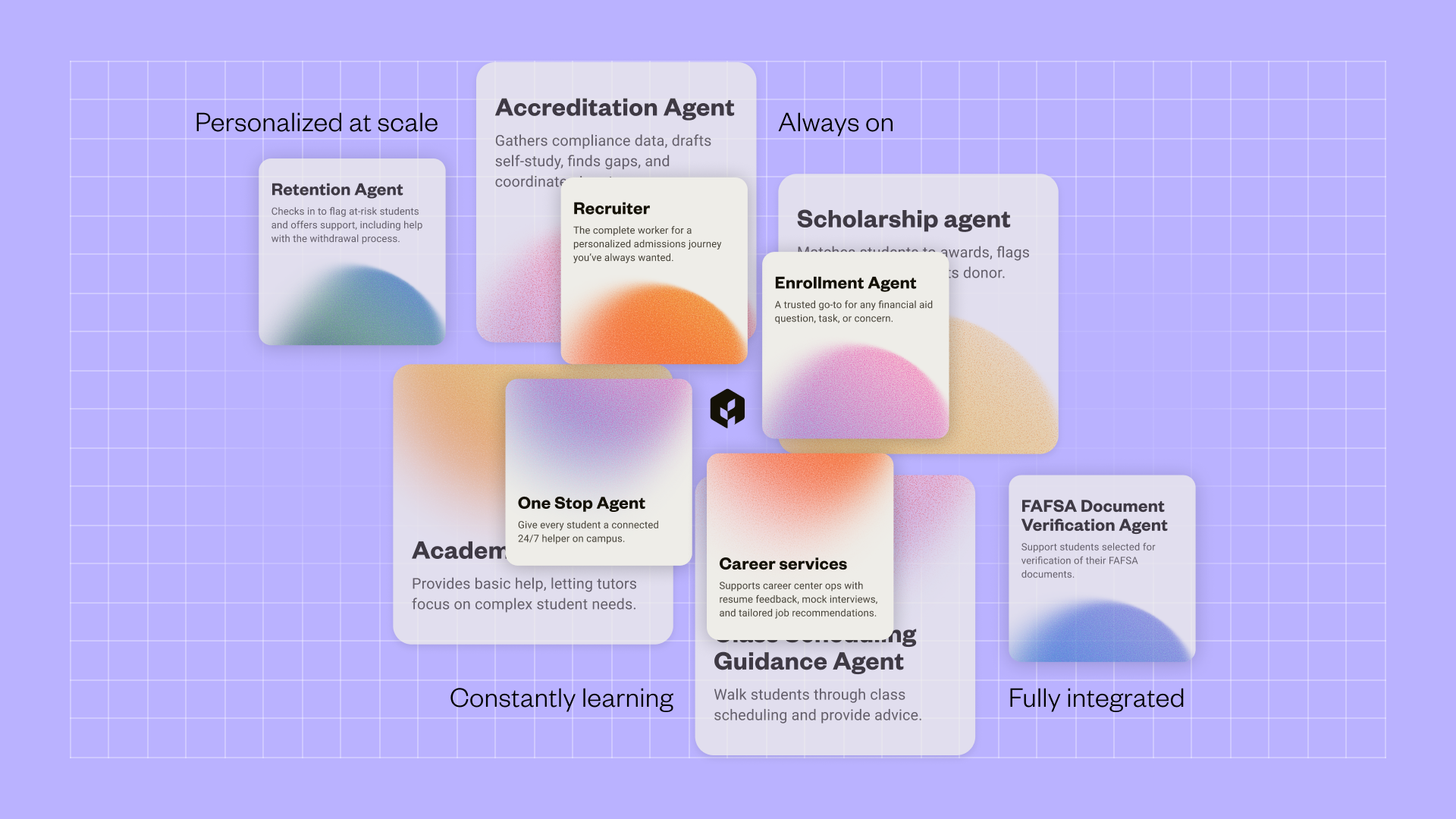
Illustration: Maria Matveeva, Brand Designer
Our history
We’re one of those rare companies that got the timing right; the kind that only makes perfect sense once AI arrived. We were far enough along to deeply understand our space, but not so far along that we couldn’t completely reinvent ourselves once models crossed a certain performance threshold. When that happened, it redefined our business.
Before that, we were selling software to university enrollment teams (a solid business with some happy customers and steady growth). But everything changed in April 2024. We realized customers weren’t using the product as much as we’d hoped. When we asked why, their answer was basically: “Don’t you see all the other things we have to do in the office?”
So, partly out of curiosity and partly out of frustration, we built a quick AI agent to handle enrollment office work. Almost immediately, customers started asking if they could pay for it. Within two weeks, we’d booked $500K in ARR. Two weeks later, another $1M. Within 30 days, we’d completely pivoted the company to focus on building AI agents for university enrollment offices.
Then came the real inflection point: about a month later, other departments across campus started asking for their own agents. That’s when we realized this wasn’t just an enrollment problem, it was an institutional one. Higher education is a $700B industry, much of which is administrative expense. It’s wildly inefficient: three administrators for every faculty member (that inefficiency is a big part of why tuition keeps rising!) So we decided to go all-in deploying AI agents across every department on campus.
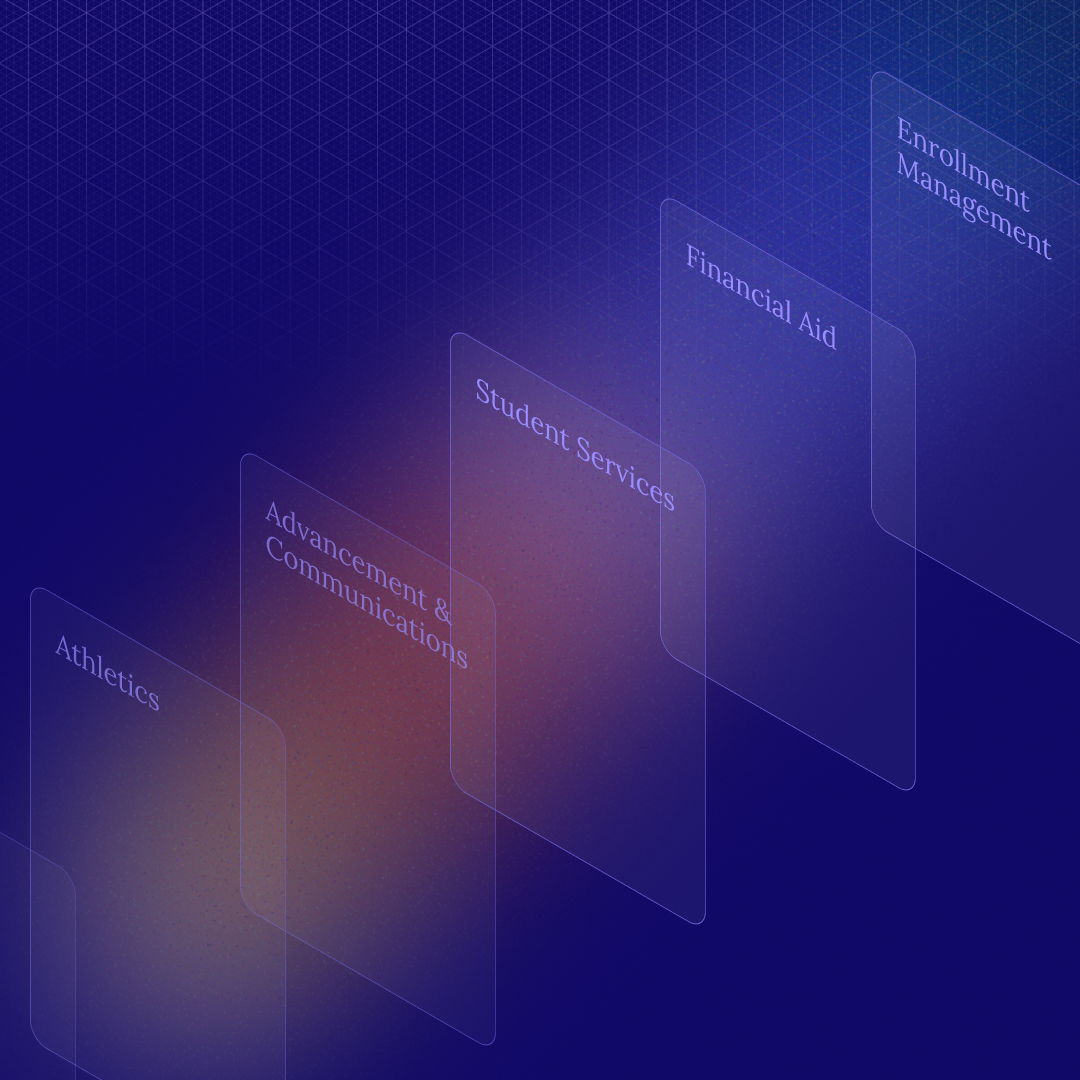
Illustration: Maria Matveeva, Brand Designer
Our platform
In June 2025 we shifted from delivering SaaS-style agentic AI applications (e.g. our AI Recruiter) to building a flexible, general-purpose agent platform. The transition followed the release of models in Q2 that crossed our internal “intelligence threshold,” enabling us to entrust models with the bulk of agent decision-making (modulo guardrails). This moment also marked the rise of industry awareness around highly performant AI agents as a black-swan economic shift (+$10T), unlocking the ability to deliver services as software into labor markets.
When we say “platform” we mean the tools, services, and infrastructure to build and operate agents across many tasks. Platforms are designed to be flexible and extensible: new features can be added, and applications are created by combining capabilities to meet specific needs.
Our platform is built around a core set of primitives for how agents do meaningful work — principles that extend beyond higher ed to enable knowledge work across many domains. Feel free to email me if you'd like more detail on how these principles map to architecture.
- Agent performance must improve as foundation models advance.
- Deploying a new agent should require no direct engineering work, unless new platform capabilities are needed.
- Agent activity must be secure by design.
- Agent activity must be safe by design.
- Agent performance and behavior must be observable and legible to stakeholders.
- We hold to an exceptionally high UX standard, inventing how humans should interact with autonomous agents.
- The platform must scale elastically to workload demands.
.png)
Illustration: Maria Matveeva, Brand Designer
While most of the sector is focused on narrowly-focused first-party agent solutions, we’re building a best-in-class platform for autonomous, third-party agents that can reason, plan, and act across many modalities. Even foundational model firms like Anthropic have noted how rare our approach is. Our ability to do this rests on:
- Technical difficulty with no viable vendors to leverage; our team is literally reading research papers and implementing them.
- Our position as the preeminent AI player in higher ed, with open runway and no competitors in sight.
- Deep technical expertise to execute at scale.
- Excellent product taste, achieving lightspeed PMF with our first AI products.
In short, what makes us unique lies not just in product abstractions, but also in the caliber of the engineering team that makes them real.
Hear from our CTO as he goes in-depth about our platform vs a point solution, capabilities that stack,
and operating non-deterministic systems safely.
Our platform engineering team
We run a deliberately flat engineering org. Most of the team reports directly to me, but within that structure engineers have what we call “benevolent dictatorship” over their work. That means owning projects end-to-end, making design decisions without waiting for consensus, moving fast without artificial resource constraints, and carrying full accountability for outcomes. We think of CollegeVine as a patronage system where we “fund” engineering projects with millions of dollars’ worth of time and resources, and in return expect extreme conscientiousness in how people work.
Our core team operates as a platform-style archetype of high-agency, high-utility engineers who contribute across the system wherever they can add the most value. We organize by absolute advantage rather than narrow specialization. While this “mini-generals” model could risk misalignment, in practice our culture balances it. We deliberately hire for judgment and collaborative instincts that act as an immune system so high-autonomy work converges instead of colliding.
Because we’re building on the bleeding edge of the product horizon, the job feels much closer to a Series A startup, even though we have the capital and stability of a Series C+. A typical day might start with a nebulous business problem. You’ll write a clear essay explaining why it matters, what options exist, and your recommended path forward. Then you’ll run a design session where the team pressure-tests the idea (sometimes with the CEO). Once it holds up, you move immediately to building a “skateboard” version to validate.
Here, engineers are also their own technical product managers. Expect more writing, reasoning, and critical thinking than you may be used to. Over a quarter, the cadence looks like ~60% build mode, 40% problem-definition/writing mode. Projects average 2.5 weeks, with 4–5 per quarter, and we checkpoint progress every two days to keep pace and momentum high.

Illustration: Maria Matveeva, Brand Designer
Your role
Now that you have a sense of what we’re doing at CollegeVine, let’s talk about the role you’ll play.
Hear from our CTO and software engineers about what it's like to build, collaborate, and own projects at CollegeVine.
First and foremost, we’re going to work together extremely closely. I mentioned above that most engineers still report directly to me (that’s true) and you’ll have direct, daily access to CollegeVine’s leadership. Engineers here are expected to play an active role in shaping the challenges they take on. I view software engineering at CollegeVine as a transformational role: through your work, you’ll help transform the company, and in doing so, you’ll transform your own career.
You’ll be joining a high talent-density team, which means you won’t just be another talented engineer solving hard problems for our customers. You’ll also be helping make both the engineering system and the engineers around you better. That might mean improving our CI/CD infrastructure, introducing a new modeling process, or offering sharp, constructive feedback on a teammate’s design. Working day in and day out with exceptional peers means you’ll be learning and teaching constantly.
If the idea of owning major projects end to end in a lean, high-velocity engineering organization sounds like a good day to you, let’s talk!
— Chris Coffey, CTO at CollegeVine
Hear from us
On this episode of The Vinedown, our CTO discusses why AI in higher ed demands real reasoning, autonomy, and responsibility — and what sets our approach apart from basic chatbots.
Hosted by our very own Emily Smith, The VineDown is a weekly podcast that features candid conversations with leaders across higher ed about emerging trends, challenges, and new ideas transforming the field.
FAQs
What’s your tech stack?
We use a mix of languages, by design. We’re not dogmatic about the “one right stack” — the goal is solving problems well. Today that looks like Ruby on the backend (though over time we know this will need to evolve as we build a more agentic platform) and PureScript on the frontend for interface work. There’s also some Python in the mix. Day to day, expect something like 70% Ruby, 20% PureScript, 10% Python. Longer term, we’d expect to port the Ruby out in favor of something more performant like Go or Rust.